A few years ago, using AI in business felt optional.
Nice to have. Good for experiments. Maybe useful for certain teams.
That’s changing fast.
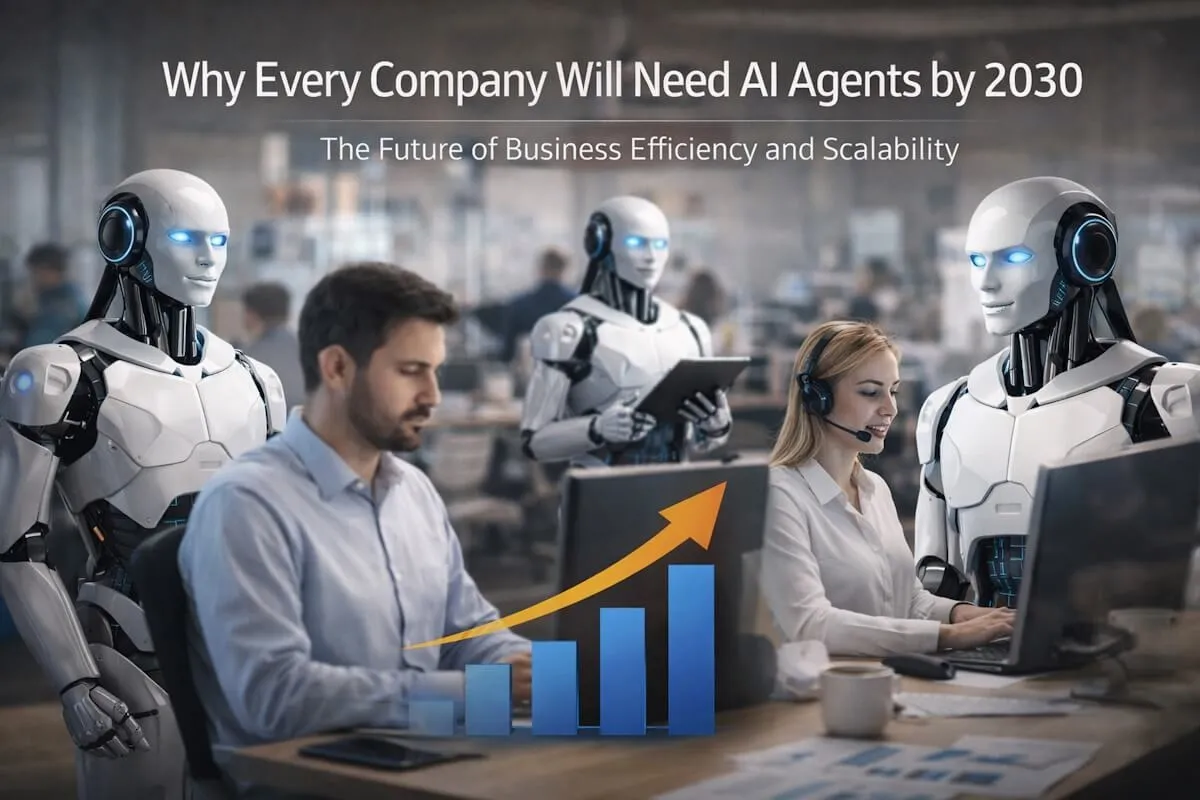
By 2030, AI agents won’t be a “nice addition.” They’ll be part of how businesses operate daily.
Not because everyone wants to follow a trend. But because the way work gets done is shifting.
And companies that don’t adapt will feel it.
Let’s talk about why this is happening.
The growing pressure on speed
Business is moving faster than ever.
Customers expect quick responses. Teams are expected to deliver faster. Markets change without much warning.
Manual execution can’t keep up with that pace.
AI agents help close that gap.
They:
- Act immediately when conditions are met
- Keep workflows moving without delays
- Handle tasks in real time
This kind of speed is hard to match manually.
And over time, it becomes the standard.
Work is becoming too complex to manage manually
As businesses grow, so does complexity.
More tools. More data. More processes.
Managing all of this manually becomes difficult.
AI agents bring structure.
They:
- Connect different systems
- Handle multi-step workflows
- Keep track of ongoing processes
This reduces the chaos that comes with scale.
Customers expect faster and better experiences
Customer expectations have changed.
People don’t want to wait hours or days for responses.
They expect:
- Quick answers
- Fast issue resolution
- Consistent communication
AI agents help meet these expectations.
They can:
- Respond instantly
- Resolve common issues
- Follow up without delay
This improves customer experience without increasing team workload.
The shift from manual execution to automated flow
Traditional workflows rely on people pushing tasks forward.
AI agents change that.
Work becomes a flow:
- Triggers lead to actions
- Actions lead to outcomes
- The system keeps moving
This reduces the need for constant supervision.
And it makes execution more efficient.
Teams can’t scale endlessly
Hiring more people is not always the solution.
It increases costs. It adds complexity. It requires more management.
AI agents allow teams to:
- Handle more work without growing at the same pace
- Focus on high-value tasks
- Reduce repetitive workload
This makes growth more sustainable.
Consistency is becoming a competitive factor
Inconsistent execution leads to problems.
Missed tasks. Delayed responses. Poor coordination.
AI agents improve consistency.
They follow defined logic.
That means:
- Tasks are handled the same way every time
- Processes stay predictable
- Errors are reduced
Consistency builds trust with customers and within teams.
Data is only useful if you act on it
Businesses collect a lot of data.
But data alone doesn’t create value.
You need to act on it.
AI agents help by:
- Monitoring data continuously
- Triggering actions based on insights
- Adjusting workflows in real time
This turns data into action.
Competitors will adopt it
This is a simple reality.
Some companies will adopt AI agents earlier than others.
Those companies will:
- Move faster
- Handle more work
- Deliver better experiences
Over time, this creates a gap.
And closing that gap becomes difficult.
Why adoption will accelerate
Right now, some businesses are still exploring.
But as tools improve and use cases become clearer, adoption will increase.
More companies will see:
- Practical results
- Clear ROI
- Easier implementation paths
This will push adoption further.
Where many businesses will need help
Adopting AI agents is not just about choosing a tool.
It involves:
- Workflow design
- System integration
- Decision structuring
That’s why businesses look for Agentic AI Development Services to build systems that fit their operations.
It makes the transition smoother.
The importance of skilled developers
Building reliable systems requires experience.
When you Hire AI Agent Developers, you’re bringing in people who understand:
- How to design workflows
- How to handle edge cases
- How to ensure consistent execution
This improves the chances of success.
Industries that will feel this shift first
Some sectors will adopt faster.
E-commerce
Handling orders, support, and logistics more efficiently.
SaaS
Managing user journeys and support at scale.
Finance
Monitoring transactions and handling routine tasks.
Healthcare
Managing scheduling and coordination.
But eventually, this will spread across industries.
What this means for your business
You don’t need to rush into full adoption.
But you should start exploring.
Ask:
- Where do we face delays?
- Which tasks are repetitive?
- Where can we improve execution speed?
These questions help you identify opportunities.
The long-term impact
By 2030, AI agents will be part of standard business operations.
Not because they’re new or trendy.
But because they solve real problems:
- Speed
- Consistency
- Scalability
And those problems exist in every business.
A shift you can’t ignore
This is not just about technology.
It’s about how work gets done.
From manual effort to automated flow.
From constant supervision to structured execution.
That’s the shift.
So, what’s your next step?
You can wait and see how things unfold.
Or you can start understanding and experimenting now.
Because the businesses that start early will have an advantage.
And by the time this becomes standard, that advantage will be hard to catch up with.
